
Published:
Workers' Comp for Florida Restaurants: What Every Owner Needs to Know
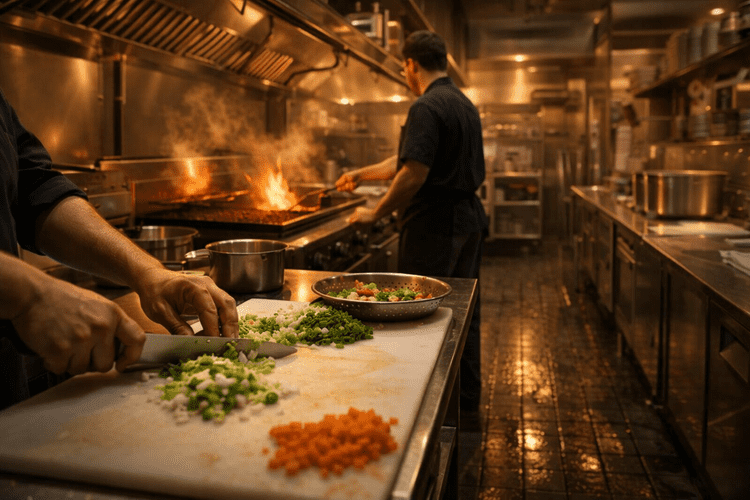
Restaurant kitchens are one of the most dangerous work environments in any industry. Sharp knives, deep fryers at 375 degrees, wet tile floors, heavy pots of boiling liquid, and a staff moving at full speed during a dinner rush.
The numbers back this up. An AmTrust Financial analysis of over 130,000 restaurant workers' compensation claims found that cuts and lacerations account for 25% of all claims. Slips and falls account for 18% of claims but 37% of total costs. Burns make up 12%. And back injuries, while less frequent, are the most expensive at $60,000 to $85,000 per claim.
The average restaurant experiences 3 to 4 workplace injuries per year, costing approximately $45,600 in total claims. If you own a restaurant in Jacksonville, Northeast Florida, or anywhere in the state, understanding when workers' comp is required, what it costs, and what happens when you do not have it is essential.
When Is Workers' Comp Required for Florida Restaurants?
Under Florida Statute § 440.02, non-construction businesses, including restaurants, must carry workers' compensation insurance when they have four or more employees. This includes the owner, full-time employees, and part-time employees.
Construction businesses have a stricter threshold of one employee. Agricultural businesses require coverage at six regular employees or twelve seasonal employees. Restaurants fall under the general non-construction rule at four.
What Happens If You Have Fewer Than Four Employees?
This is where most restaurant owners get confused. If you have three employees, Florida law does not require you to carry workers' comp. But that does not mean you are protected.
Without workers' comp, you are personally liable for every workplace injury. If your prep cook burns their hand on a fryer, that emergency room visit, the follow-up care, the lost wages while they recover, all of that comes out of your business. Or your personal assets.
We recommend workers' compensation for any restaurant with employees, regardless of the legal threshold. The cost is modest compared to the exposure. Workers' comp is a core part of any restaurant insurance program we build for clients.
The Five Most Common Restaurant Workers' Comp Claims
Understanding what actually happens in restaurant kitchens helps explain why workers' comp matters so much in this industry.
- Cuts and lacerations (25% of claims).
Knives, slicers, broken glass, and food processor blades. The most frequent injury. Average cost per claim: $1,798. Relatively inexpensive per incident but high in volume. - Slips and falls (18% of claims, 37% of total cost).
Wet floors, grease spills, cluttered walkways. These produce the highest total cost because they often result in sprains, fractures, and back injuries. Average cost per claim for strains: $10,672. For fractures: $22,837. - Burns and scalds (12% of claims).
Deep fryers, grills, boiling water, steam, and hot plates. Average cost: $4,326 per claim. Severity ranges widely from minor first-degree burns to hospitalizations. - Back injuries and strains (8% of claims but highest cost).
Lifting heavy pots, supply boxes, bus tubs. Back injuries average $60,000 to $85,000 per claim and can result in long-term disability. One serious back injury can cost more than a year of workers' comp premiums. - Repetitive stress injuries.
Carpal tunnel from chopping, tendinitis from repetitive plating motions, chronic foot and knee pain from standing on hard floors for 8 to 12 hour shifts.
Data source: AmTrust Financial analysis of 130,000+ restaurant workers' compensation claims over six years, reported by Risk & Insurance magazine (2025).
How Much Does Workers' Comp Cost for a Florida Restaurant?
Workers' compensation premiums are calculated as a rate per $100 of payroll, based on your employees' job classification. Florida uses NCCI class codes to determine the base rate.
For 2026, the two restaurant class codes in Florida are:
- Class Code 9082 — Restaurant NOC:
$1.16 per $100 of payroll. This applies to most sit-down restaurants, cafes, and bars. - Class Code 9083 — Restaurant Fast Food:
$1.20 per $100 of payroll. This applies to fast food and counter-service operations.
Every workers' comp policy in Florida also includes a $160 annual expense constant, which is a flat administrative charge added to the premium regardless of payroll size.
| Restaurant Size | Approx. Annual Payroll | Estimated Annual WC Premium |
|---|---|---|
| Small (5 employees) | $150,000 | $1,900 ($1,740 + $160 expense constant) |
| Mid-size (15 employees) | $400,000 | $4,800 ($4,640 + $160 expense constant) |
| Larger (25+ employees) | $700,000 | $8,280 ($8,120 + $160 expense constant) |
Calculated using 2026 Florida NCCI class code 9082 at $1.16 per $100 payroll plus $160 expense constant. Actual premium may vary based on experience modification (for larger accounts), carrier schedule credits or debits, and any applicable surcharges. Contact our office for an actual quote.
If your restaurant has both kitchen staff and administrative or clerical employees, the clerical payroll may be separated into a lower-rated class code, which reduces the overall premium. Accurate classification matters. We review this on every account.
Workers' Comp Premiums Are Auditable
Your workers' comp premium is based on estimated payroll at the start of the policy. At the end of the year, the carrier audits your actual payroll. If you hired more staff or gave raises, you owe additional premium. If payroll came in lower than projected, you get a refund. This is standard for all workers' comp policies and catches some restaurant owners off guard at year-end.
What Is an Experience Modification Rate?
Larger workers' comp policies (generally those above a certain premium threshold) receive an experience modification rate, or EMR. An EMR of 1.0 is average for your industry class. Fewer claims than average pushes it below 1.0 and lowers your premium. More claims pushes it above 1.0 and increases your cost.
Most small restaurants with only a few employees will not have an EMR assigned because their premium is below the threshold. But claims history still matters. Even without a formal experience mod, carriers review your loss history at renewal. A restaurant with frequent claims will see higher rates or non-renewal regardless of size.
Five Ways to Lower Your Restaurant Workers' Comp Cost
- Implement a documented safety program.
Restaurants with formal monthly safety meetings and written protocols experience 40% fewer workers' comp claims, according to the National Restaurant Association. Some insurers offer premium discounts for documented training. - Require non-slip footwear.
Slip-resistant shoes are the single most cost-effective injury prevention measure in a restaurant. Some carriers offer boot stipend programs or discounts for mandatory footwear policies. - Train on proper lifting techniques.
Back injuries are the most expensive claim category. Training on team lifting for heavy items, proper squat form, and using carts instead of carrying reduces frequency significantly. - Classify employees accurately.
Kitchen staff, servers, and administrative employees carry different class codes with different rates. Misclassifying a manager as a line cook inflates your premium. Misclassifying the other direction can leave you underinsured and trigger audit penalties. - Report claims promptly.
Florida requires employers to report workplace injuries to their carrier within seven days. Late reporting increases claim costs and can trigger penalties. Fast reporting also allows the carrier to manage medical care early, which reduces total claim cost.
Does Workers' Comp Cover the Restaurant Owner?
In Florida, corporate officers and LLC members can elect to exempt themselves from workers' compensation coverage by filing a Notice of Election to be Exempt with the state. For non-construction businesses, up to three officers or members may be exempt.
But exempting yourself means you have no coverage for your own workplace injuries. If you are working in the kitchen alongside your staff and burn yourself, your workers' comp policy will not cover you. Whether to include or exclude yourself is a financial decision that depends on your personal health insurance and risk tolerance. We review this with every restaurant client.
Is Your Restaurant's Workers' Comp Right?
Let us review your current program. We will check your classifications, your claims history, and your carrier to make sure you are properly covered and not overpaying.
Important: This article is for educational purposes only and does not constitute insurance or legal advice. Cost estimates, premium calculations, and coverage descriptions are illustrative and not a guarantee of coverage, insurability, or premium. Actual policy terms, rates, and conditions are determined by the carrier and subject to underwriting approval. For specific coverage recommendations for your restaurant, contact our office at (904) 268-3106 or request a quote online.
Sources
- Florida Legislature. Florida Statute § 440.02. Workers' compensation required for non-construction employers with four or more employees. leg.state.fl.us
- NCCI (National Council on Compensation Insurance). 2026 Florida Workers' Compensation Class Code Rates. Class 9082 Restaurant NOC: $1.16 per $100 payroll. Class 9083 Restaurant Fast Food: $1.20 per $100 payroll. Expense constant: $160. Effective 1/1/2026.
- AmTrust Financial. Analysis of 130,000+ restaurant workers' compensation claims over six years. Cuts account for 25% of claims. Slips and falls account for 18% of claims and 37% of total cost. Strains average $10,672 per claim. Fractures average $22,837. Reported by Risk & Insurance magazine, October 2025. riskandinsurance.com
- 1800Insurance.com. "Workers' Comp for Restaurants: Costs, Codes & Coverage 2025." Average restaurant experiences 3-4 injuries per year costing approximately $45,600 total. Back injuries cost $60,000 to $85,000 per claim. 1800insurance.com
- National Restaurant Association. Restaurants with documented monthly safety meetings and written protocols experience 40% fewer workers' compensation claims. restaurant.org
- Florida Division of Workers' Compensation. Laws, rules, and penalty information. myfloridacfo.com
- Mosey.com. "Florida Workers Compensation Rules for Employers." Penalty relief for first-time violators: 25% reduction for cooperation + 15% for completing online tutorial = up to 40% reduction. mosey.com

Susan Augustyniak, CIC
Vice President, Augustyniak Insurance Group
Certified Insurance Counselor with 25+ years in the industry. Susan helps Florida restaurant owners build workers' compensation programs that protect their employees and their business. This article was published in May 2026.
Related: Restaurant Insurance Jacksonville FL · Workers' Compensation Insurance · Business Insurance Jacksonville FL